Hey there, fellow off-gridders, campers, and anyone who’s ever stared at a dead fridge mid-camping trip or a fried work laptop during a blackout—let’s talk about something that’s way more important for your large portable power station than its flashy watt numbers: power factor. Specifically, the power factor of those 2200W to 3600W big boys we sell as a supplier, because I see so many folks sleep on this detail when they’re shopping for a reliable portable power setup. Large Portable Power Stations 2200W–3600W

First off, let’s keep this real—no engineering jargon that makes your eyes cross. If you’ve ever plugged a phone into a power strip and wondered why sometimes things draw more current than you’d expect for their wattage, that’s power factor at play. In simple terms, power factor (let’s just call it PF from here on, yeah?) is the ratio of how much actual useful power your power station sends out vs. how much total power it’s pulling to run that gear. Think of it like this: if you have a cooler that needs 100W to run, but your power station has to draw 110W total to make that cooler work smoothly, your PF is about 0.9 (100/110). The closer PF is to 1.0, the less “wasted” power the station is using, which means longer run times, happier devices, and less strain on your power station’s battery.
Now, I work with these 2200W to 3600W units every single day—they’re our bread and butter for people who need to run heavy gear: mini fridges, power tools, space heaters, even small AC units. And I’m gonna be straight with you: most quality large portable power stations in this 2.2kW to 3.6kW range have a PF between 0.9 and 0.95. Wait, why isn’t it 1.0? Well, here’s the thing—portable power stations use inverters to turn DC battery power into AC power that works with your home gear, right? And inverters (especially the modified sine wave ones, but even pure sine wave) have tiny little inefficiencies that make PF dip just a hair. The good news is, 0.9 and up is actually super solid for this size of unit. Anything below 0.8 starts to get sketchy, because that means you’re wasting almost 20% of your battery power just sending current back and forth that doesn’t actually do work.
Let me give you a real example from our shop to make this concrete. Last month, a guy came in looking for a station to power his construction site’s 2500W circular saw and a small jobsite fridge. He was comparing two units—one he found online that claimed 3600W, and our 3000W model. The online one listed its PF as 0.7, our unit was 0.92. He thought the 3600W one was better because of the higher wattage, but we broke it down for him: his saw and fridge needed a combined useful 2600W. The online station would’ve needed to pull ~3700W total from its battery to hit that, which would’ve dropped its run time from 8 hours to like 5.5 hours. Our station? It pulls ~2826W total, so run time stayed right around 7.5 hours—plus, the higher PF meant it didn’t overheat when running both heavy tools at once, which is a big deal on a jobsite where you can’t pause to let it cool down.
Another thing I’ve noticed with these large 2200W–3600W units: the PF isn’t just a random number the manufacturer pulls out of thin air. It depends on two big things: the inverter technology and the load you’re running it with. Pure sine wave inverters (which all our units use, by the way—no modified sine wave garbage for our heavy-duty stuff) naturally have a higher PF than modified ones because they mimic the exact AC power from your wall, so devices don’t have to work extra to adjust. And when you’re running a full load (like 3000W on a 3600W station), the PF stays consistent. If you’re running a light load, say 500W to a phone and a lamp, the PF might dip a tiny bit to like 0.85, but that’s totally normal for any power station—no need to panic there.
Wait, let’s address a myth I hear all the time: “Higher wattage always means better PF.” Nope. A lot of cheap 3600W units you see on Amazon or big box stores cut corners on their inverters to hit that high peak wattage, and their PF is garbage. Those 0.6 to 0.7 PF units look good on paper, but they’re terrible for real use because you’re draining your battery way faster than you should. For context, a PF of 0.9 means 90% of the power from the station is actually used to run your gear; a PF of 0.7 means only 70% is useful, the other 30% is just wasted as heat in the inverter. That extra heat can also shorten the life of your power station’s battery, which is a huge investment.
At our company, we test every single 2200W to 3600W power station we ship to make sure their PF hits at least 0.9 when running at 50% to 100% load. Why? Because we’ve talked to hundreds of customers who’ve been burned by cheap units—campers whose 3000W station died halfway through a weekend because its PF was too low, contractors who had to carry extra batteries because their station wasted power. We don’t do that. We build these units to be workhorses, so their PF is optimized for real-world use, not just flashy marketing numbers.
Let’s talk about how this affects you, the customer. If you’re buying a 2200W–3600W power station, here’s what PF means for your wallet and your use: longer run times. Take a 3000W station with a 1500Wh battery (that’s a common size for this range). If it has a PF of 0.9, at 100% load (3000W useful), it can run for about 0.45 hours (27 minutes). If it had a PF of 0.7, that same run time would drop to ~0.35 hours (21 minutes). For a weekend camping trip, that means you’re either recharging more often or leaving a cooler off longer. For a jobsite, that means more downtime waiting for batteries to charge instead of working.
Another point: some devices are more sensitive to low PF than others. Things with motors—fridges, AC units, power tools—need a consistent, high PF to run smoothly. If your power station has a low PF, you might notice your fridge cycling on and off more often, or your circular saw underperforming. We had a customer last year who bought a cheap 2500W unit for his off-grid cabin; his 1500W mini fridge would only run for 2 hours before the station died, and it sounded like it was straining the whole time. He swapped to our 2800W unit with a 0.93 PF, and that fridge runs for 10 hours straight, no straining, no issues. He said it was like getting a whole new fridge without buying a new one.
Now, I know what you’re thinking: “How do I check the PF of a power station I’m buying online?” Good question, because a lot of brands hide this detail. First, look for units that say “pure sine wave inverter”—that’s a good sign for a higher PF. For our units, we list the PF right on the spec sheet, because we’re not gonna hide it. If a brand doesn’t list PF at all, that’s a red flag. If they do list it, make sure it’s for at least 50% to 100% load (light load PF is always lower, so don’t judge based on that). Anything 0.85 and up is decent for this size, but 0.9 and higher is the sweet spot for reliable performance.
Here’s a quick recap for anyone who skipped the middle part:
- For 2200W–3600W large portable power stations, PF is between ~0.85 and 0.95 for quality units.
- Higher PF means less wasted power, longer run times, longer battery life.
- Cheap units often have PF below 0.8, which is a bad deal for real use.
- Always check PF and inverter type (pure sine wave) when shopping, don’t just go by peak wattage.
At our company, we’ve been supplying these large portable power stations for over 10 years, and the number one question we get after “how long does it take to charge?” is about PF. People are finally catching on that this tiny number makes a huge difference. We’ve built our reputation on being transparent—we don’t inflate wattage numbers, we don’t hide bad specs, we just sell reliable units that get the job done.
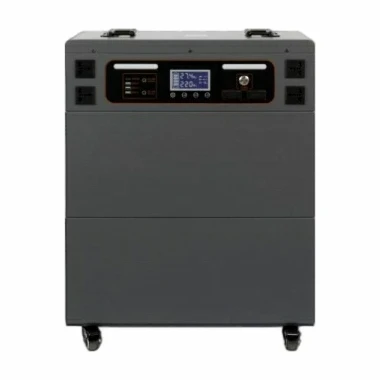
If you’re in the market for a 2200W to 3600W power station—whether it’s for camping, off-grid living, a jobsite, or backup power for your home—let’s chat. We can walk you through our different models, explain the specs in plain English (no jargon, I promise), and help you pick the one that fits your needs and budget. We’ve worked with everyone from weekend campers to large construction companies, and we’re here to make sure you get a power station that actually works for you, not one that looks good on a product page.
Trolley Heavy-Duty Power Stations 4000W–5000W References
- International Electrotechnical Commission. (2015). Power factor definitions and testing for low-voltage AC power equipment. IEC 61000-3-2:2015.
- Portable Power Station Association. (2022). Technical guide for large-format portable energy storage units, inverter performance, and power factor optimization.
- Energy Star. (2021). Understanding power factor for portable power products and energy efficiency in off-grid applications.
Guangdong Joinwin Global Digital Intelligence Technology Co., Ltd.
As one of the most professional large portable power stations 2200w–3600w manufacturers in China, we have world-leading production equipment and strong manufacturing capabilities. Please rest assured to buy high quality large portable power stations 2200w–3600w from our factory. Customized orders are welcome.
Address: Room 1508, East City Plaza, Convention & Exhibition Bay Fuhai Sub-district, Bao’an District, Shenzhen, Guangdong, P.R. China
E-mail: bruceyang@joinwinenergy.com
WebSite: https://www.joinwinpower.com/
